L/O To know about the effects of snow across Europe this week.
Over the past week or so snow has caused no end of disruption across Europe. To help us understand a bit more about it some classes will be learning more of the effects.
The tasks are outlined on the document below. For a map of Europe click here.
Make sure your work has a clear title and is well presented. You could also add some images.
Last of all don't forget to try some of the challenge tasks!!!
Thursday, 12 January 2017

Thursday, 5 January 2017
Snow Day
Another January, another snow day, this one called before the snow even started. If you want to learn a bit more about snow have a look at this post that I shared last year.
I you have any great pictures of the snow then get sharing or have a go at one or more of the tasks!!
There will be housepoints for the best pieces of work and they will be displayed either in the classroom or here on the blog
1. Watch this video and create a poster explaining how snow forms
2. Watch this video about the design of Snowflakes. Create a fact sheet about snow flakes.
3. Yesterday I too these pictures of the snow near my apartment. Sadly it's not a lightsaber, just a lucky shot as the snow fell past the phone. Look at the damage done to the trees near my building.
Take your camera (or your phone) and get out in your neighbourhood. How many different snow pictures can you take? Can we get enough pictures to make a visual map of the snow in Bucharest, email me your shots or if you use Instagram use #ibsbgeographysnow and follow me @ibsbgeography.


4. Search on news sites to see just how many different ways snow can affect every day life. We have already been affected with school closing. If you run a business then during days like this you will probably lose money, what about sports fixtures, people who are travelling. Create a mind map to show all the possible effects of heavy snow.
5. Go out in the snow and enjoy it while you can!!
Tuesday, 25 October 2016
Runaway Heathrow?
In the news today the UK government has decided that a third runway for Heathrow is the best option for the UK to continue competing globally, especially after the EU referendum.
This has been debated for years in the UK, the current Prime Minister herself was against the proposal before her elevation to the hot seat.
If you're interested take a look at the video which shows current air traffic patterns over the UK, is there really room for more planes?
If you're keen to know even more about the project then check out the links I will be putting into Pinterest.
Heathrow Expansion Links
Personally I think the UK is making a mistake with this decision, the impact will be too great environmentally and socially with any benefits reaching too few of the population. What do you think?
Sunday, 28 August 2016
Welcome back!!
What an interesting summer it has been. Personally I have been to Greece for the first time and loved it (apart from the extreme heat), I climbed another volcano and went deep into a huge cave system. The UK was a bit cooler, and I finally got to see a stage performance of 1984, one of my favourite books, and just weeks after the final an FA Cup qualifying game. (1-1, a missed penalty and a red card) I always look forward to hearing the amazing places you have visited over the summer, please feel free to share them during the next three weeks.
Over the past 8 weeks or so there have been so many stories happening around the world. Who would have thought a country with more volcanoes from professional footballers would beat the country who 'invented football'? That the UK would choose to 'Brexit', whatever that ultimately ends up meaning? Or that the UK would surpass it's medal total from the London Olympics in Rio? Globally we are witnessing the US presidential race heat up as November approaches and policing under the microscope more than ever.
Geography has been in the news throughout the summer, much of what is above could be looked at through Geographical glasses, fracking refuses to frack off despite the dangers it poses. Nuclear power is still on the UK agenda, linking strongly to China one of the world's super powers. Flooding has hit parts of the USA with incredible footage of a woman being rescued from her car moments before drowning along with her dog.
Sadly just this week Italy has experienced a terrible earthquake, something Romania is no stranger to. At the time of writing the death toll is at 290 with huge amounts of damage. I will put together a more detailed post on this over the week. As somewhere I have huge affection for my thoughts are with Italy and everyone affected along with Burma which also suffered an Earthquake though it appears the death toll is significantly lower. Read more about why there were different effects on the Earth Story Facebook page.
So a new term, this year KS3 have a bit more time for Geography, we will have 3 hours per fortnight. This means one week you will have 2 lessons, and the week after 1 rotating through the year. What will you be studying in KS3? (KS4 and KS5 information will follow later)
Year 7
Introducing Geography and the Geography of Romania and EU
Maps and Mapping
Africa
Volcanoes
Rivers
Year 8
Weather
Population
Cities
Climate Change
Coasts
Year 9
The Earth's Resources
Development
The Middle East
Russia
The Physical Geography of Romania
Please be aware that at times we will deviate from this to incorporate significant global events, last year we started the year exploring the ongoing migrant crisis in Europe, migration of course being a key issues with regards to population.
You will still be assessed using the schools assessment week, based on feedback from last year I will be adapting the criteria to make them simpler to use.
For resources I have requested the use of Kerboodle online text books which will improve the flexibility of our course, and means one less book to carry around and should mean less paper being used. This will be used along with a range of other resources which are currently being developed with further information to follow soon.
After quite a lengthy post all that is left to say is enjoy the year and comment/email me with any questions, you will all have my email address.
Good luck!!
Wednesday, 3 August 2016
Santorini Volcano
If you have been to Santorini you will not know that island is Volcanic as part of a huge caldera, surrounding the Volcano of Nea Kamini. If you arrived by boat then you will have travelled past the volcano and seen tourists trekking their way to the top. If you were able to drag yourself away from the towns, sunsets and beaches you might have taken a boat trip out to learn a little bit more, even to swim in the hot springs on the far side.
Our knowledgeable guide informed us that there would be no chance of an eruption during our visit, though the magma chamber was slowly being filled up as the African plate is subducted under the Eurasian. As this happens the oceanic crust is destroyed ready for the next eruption. Currently the volcano is classed as dormant, as a reminder that the status will one day change we kicked up some dirt and just below the surface the temperature of the stones was enough to burn your hands if you weren't careful.
The volcano island is made up of several craters relating to previous eruptions, the most recent being 1950. You can see gases escaping from cracks in the rocks as you stare into a graveyard of the poorly secured hats littering the crater sides.
Another key point to notice is the different colour of the igneous (volcanic) rocks, this is due to the rate at which the rock cools and the amount of oxygen reacting with it as this happens.
It is unlikely there will be another eruption on the scale that destroyed the town of Akrotiri, Greece's very own Pompeii. It has been difficult to date to the biggest eruption, it was sometime during 1600 BCE which impact the Mediterranean directly, causing destruction to settlements on Crete and potentially impacting global climate patterns, records in Egypt describe significant changes around the same time.
Once you've climbed up what better way to finish the trip than heading to the far side of the volcano for a swim in the hotspring where you notice the change in the temperature as you move closer to the island. The water is supposed to be good for your skin, though not so good for a white swimming costume!!
Have you been somewhere Geographical you would like to write about? Email me or speak to me when we start back at school.
For those of you interested here are a few more weblinks to explore for more information including a like webcam.
https://www.volcanodiscovery.com/santorini.html
https://webcams.volcanodiscovery.com/Santorini
http://www.thisoldearth.net/Igneous-Rocks_color.cfm
https://www.santorini.com/archaeology/akrotiri.htm
 |
| Amazing colours |


 |
| The town of Thira from Nea Kamini |
 |
| Crater |
 |
| Gas Vent |
 |
| Monitoring Equipment |
 |
| Plants slowly reappearing |
 |
| The small port. Note the yellow water. |
Friday, 20 May 2016
Mud, lots of mud
Year 7 took a break from being in the classroom to head out into the field this week. Our destination? The Mud Volcanoes of the Buzau Mountains. Don't worry these aren't the type of volcanoes that will lay waste to your house, disrupt your holiday through volcanic ash, or even get turned into a disaster movie. They are pretty cool and impressive all the same.

So why do they exist? Well put simply there is oil under the surface, as much as 30,000 metres deep. The oil gives off gas. This gas rises up through cracks in the rock, some of the rock it passes through is clay. This mixes with underground water to get the liquid mud 'erupting' out in volcano shaped cone. Due to the oil you will notice a smell similar to petrol whilst you are in the area.


Some of these volcanoes are constantly erupting meaning you watch them in action, others are more intermittent. You can see where the mud has recently erupted as fresh flows carve out mini gorges as they meander, in the same way water does in a river down the hill.


Of course, there is a very real risk of getting muddy in a place like this, so make sure you take a change of clothes just in case, and remember this.
There is a reason why you should tie your shoes up properly!!


Tuesday, 17 May 2016
This term in Geography
As the year draws to close we have three final topics in KS3 for students. Due to the nature of the term these topics will be short and focus on some of the main points of the issues.
Year 7
Year 7 will be looking at Rivers, they will explore the 3 main stages of a river. These are the Upper Middle and Lower courses. In doing so they will learn about some of the landforms associated with them and the processes used in forming them.
This video based on the River Severn in the UK gives an overview of how a river changes from the source to the mouth.
As part of their last unit on Plate Tectonics Year 7 will also have the opportunity to visit the Mud Volcanoes near Buzau. When we return from the trip I will write a separate post.
Year 8
Coasts and population is the year 8 topic. This will be based around a field trip to Constanta, students on the trip will practice methods of data collection and see first hand how people interact with the coastline. In the lessons leading up to the trip students will learn these techniques and about the process occurring along coastlines.
Once such technique involves deciding if waves are Constructive or Destructive, we can do this by counting waves and looking at their characteristics. Something students have already tried with this video.
To help you decide if these waves are constructive or destructive take a look at this link from the BBC.
Year 9
Globalisation, a topic that will be relevant to all students whether they are choosing to continue with Geography next year. It has strong links to Business and Economics and something which impacts all of us as we go through life.
Students will be exploring the positives and negatives of Globalisation and considering what the future holds as we potentially become more and more globalised.
This video helps us think about it even though it is packaged as a history video it is full of Geography.
Tuesday, 19 April 2016
Ecuador Earthquake
In the past week there have been two major earthquakes, first in Japan followed by one in Ecuador. Given their levels of development the Ecuador quake has had a much larger impact on the population. I have started collecting links onto Pinterest.
Between now and the end of term year 9 will be looking into this Earthquake to find out more about what has happened and how the recovery will go.
For those of your either studying GCSE or thinking of studying at GCSE this could be a useful case study to consider. It should go without saying that 6th formers should be keeping an eye on what is happening too!
Monday, 18 April 2016
Where are you really looking?
If you've been to the coast then you've probably asked 'What is on the other side?' For the most part you can't actually see to the other side of an ocean or sea. Though in South Wales you can see across to England though this is technically the Bristol Channel, not a sea or ocean.


If you’re on the beach, this map shows you what’s across the ocean
Growing up where I did in the Midlands, there were trips to places like Cleethorpes and Skegness. Look them up, I doubt they are places you would visit if you are in the UK. I always assumed if I could see then it would be Holland that I could see, beyond that I never gave it another thought.
One man, Andy Woodruff, a cartographer, has tried to answer this question and has produced maps to give you an idea of where you are actually looking at even if you can't see it.
By his own admission some of the maths may not be 100% accurate but the logic appears to make sense. Take a look at the maps below to gain an idea of how it works.
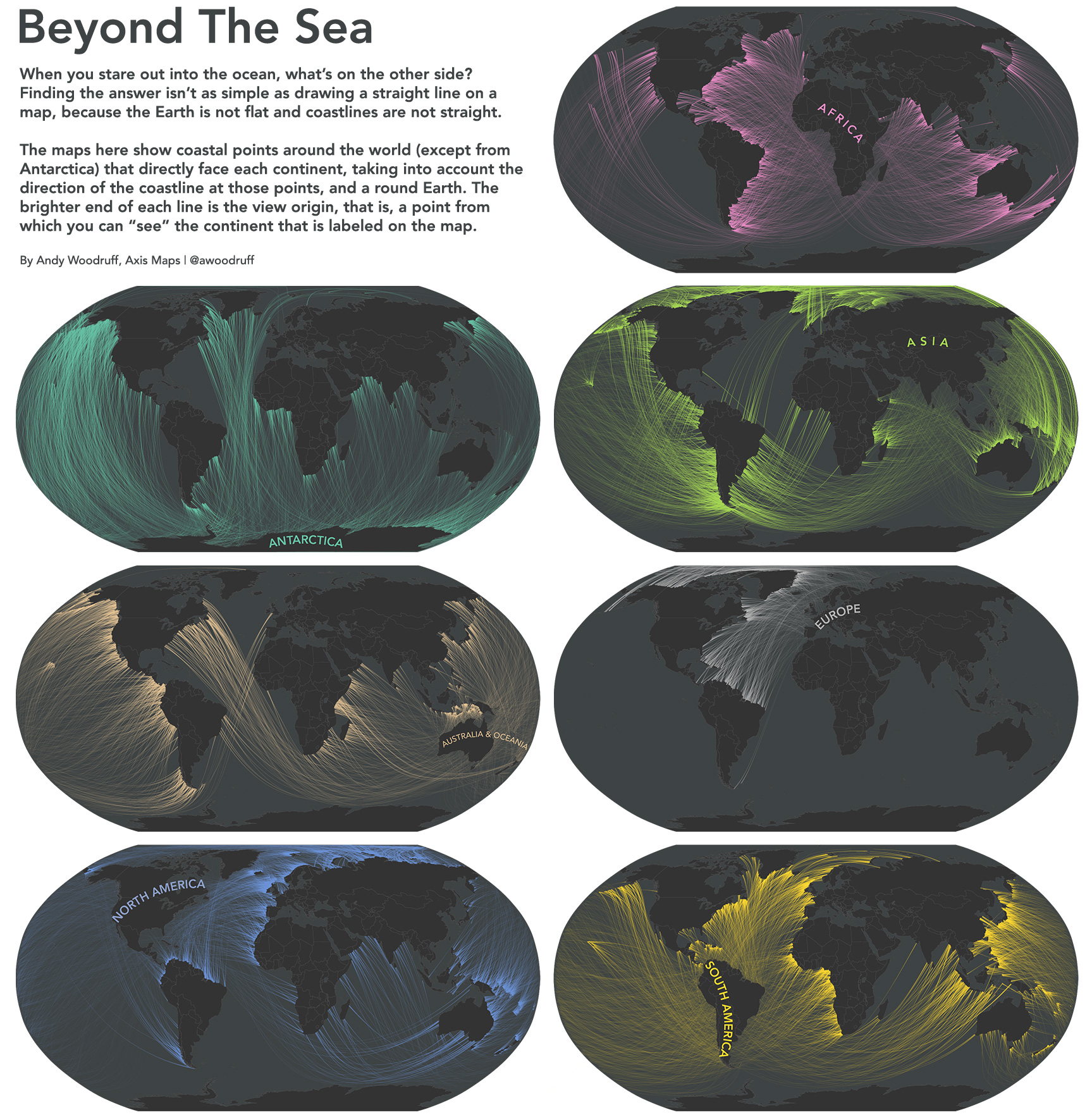
His work builds on ideas from reporters at the Washington Post, they mapped out which places would be on the same latitude. Keep in mind though, that being on the same latitude does not mean you would see this place due the angle of the coastline.
This map gives you an idea of this project.
If this is something you find interesting you can read all the articles by following the links below. Where you do think you are looking at if you visit the coast in Romania? Can you work it out?
Tuesday, 29 March 2016
Volcanoes
In the news today two different volcanoes have erupted, the video below shows Mexico's Popocatepetl volcano spewing ash and gas into the sky.
Popocatépetl volcano came to life on Sunday morning, sending a column of gas and ash 2,000 metres (6,500ft) into the sky in central Mexico. A 12km (7.5-mile) security ring around the volcano has been mandated, preventing passage close to the crater. Popocatépetl’s last major eruption was in 2000, when more than 40,000 people had to be evacuated
The second eruption occurred in Alaska, I don't have a video just yet if you find one you can add it in the comments. A link to read about what is happening is here...
Alaska volcano spews ash cloud stretching 400 miles, grounding flights
Thursday, 24 March 2016
Romania
Speaking to some of you during the week many of you are travelling this holiday. If like me you are staying in Romania here are two interesting videos about the amazing country we live in. The first some of year 9 may have seen whilst looking at mountains looking at the Carpathians. The second the Danube from the Black Forest to the Black sea following the Danube through to Romania and out through the delta. Where ever you are going enjoy and have a great trip!!
Monday, 25 January 2016
Why should I choose Geography?
For those of you in year 9 you will soon be choosing your options. Many of you have probably already made up your minds of what you want to choose.
Ultimately the decision is yours, before you tick that box though stop and think about your choice. Have you considered everything that studying Geography can do for you?
Why don't you start by watching this video to see if Geography can help you decide.
The President of the Royal Geographical Society has this message, highlighting just important Geography is. Read it through with your parents and discuss how Geography can benefit you. It is aimed at UK students with references to the UK and those points apply to us here as a British International School.

Still not convinced, check out this video from Google to show many ways Geography is used in the world and the potential opportunities it can open up for you.
There is a demand in the work place for people who have studied Geography, study Geography and you will find employment in an ever changing world easier to come by. (Just remember you still have to study).

Still not convinced but want to know more, why not hear what some Geography graduates have to say. Remember they started with GCSE Geography and look at them now.

If you want to know more about the course then speak to Mr Storey, there will be another post soon regarding the specifics of IGCSE Geography. You can also email at the usual address or use twitter @mstgeography or #ibsbgeography to ask questions.
Whatever you choose for your options it has been a pleasure teaching you these past two years. I hope to continue teaching you next year. Either way I wish you all the best for your GCSEs and the door is always open.
Monday, 4 January 2016
1000 Places to visit before you die challenge
New for this year in your Geography room is the 1000 places to see before you die. To link in with this each month there will be a challenge related to the location displayed on it.

As it is a challenge there will be prizes, every entry will earn 5 House points, with more available for outstanding efforts. Good luck and to have a chance of winning just hand in on paper your entry by the 31st of January.

Sunday, 27 December 2015
North of England Floods
Boxing day is usually a day of recovering from or continuing with the excesses of Christmas Day. For many parts of the UK the month of December has been one long nightmare. First Desmond and now Eva have dropped their rainfall onto large parts of the UK with the North of England causing widespread flooding.
The two maps below show live flood warnings for December 26th at around 10pm. These are taken from the Environment Agency and you can see below just how many warnings were in place.


Obviously there is a huge amount of news coverage, making it difficult to sum up everything. . The BBC introduction gives you some idea of the devastation. Below you will find some news sites below to get a real understanding of what is happening

BBC Live reports Sunday December 27th
Guardian Live reports Sunday December 27th
Pinterest Board about the floods
Thursday, 24 December 2015
UK Floods - Storm Desmond
Desmond caused huge amounts of damage across parts of the UK this December, particularly in parts of Cumbria which has now experience several large flood events over recent years, this has now developed further with Storm Eva which I will post about soon.
Before the holiday students had the chance to research the flood to explore the impact of peoples lives.
Anisia found out the following information along with some footage of the flooding.
The UK flooding is a recent problem that people face daily now in some parts of the UK. This damage was caused over the last 3 days and had made it harder for everybody in the UK (parts that are affected) to travel from place to place and even difficult to get out of the house, if the house is still in good shape. Schools, hospital services and travel have been disrupted after Storm Desmond brought winds, terrifying rain and flooding to the UK, making them towns of rivers. In Cumbria and Lancashire more than 43,000 homes are suffering from power cuts, while an estimated 5,200 homes have been affected by flooding.

Meilin found used a Guardian article and found out...
The flood and rain in the UK has made headlines in most newspapers. Thousands of homes and businesses have been consumed by the flood, across northern England and Scotland.Weather forecasts say that the heavy rain and wind will persist for the up coming weeks. Luckily, people will not have to pay council taxes and business rates until they are back to their properties.
The rain keeps on coming and just last night December 23rd more flooding was taking place.
Tuesday, 22 December 2015
Pompeii
If you have not yet found the time to visit Pompeii then I suggest you put it on your list of places to visit. Whilst you're there check out Napoli for some of, if not the best pizza you will ever eat, and the stunning Costiera Amalfitana (Amalfi Coast), just try and explore more than the standard tourist places for a far more interesting experience.
Pompeii itself is an incredibly interesting place to visit, all the time you are in the shadow of Vesuvius, which hopefully you can find the time to visit. Then imagine that the volcano you are seeing was once much taller and one giant feature on the landscape. Take the time to explore and in the summer be prepared for the heat.
Pompeii the film is set in the last days of the now famous town. The plot is, much like Titanic is very predictable and so it should be no surprise to you that the Volcano erupts and the town is destroyed. The effects put into the film are certainly impressive and give you some idea of what it could have been like.
"A slave-turned-gladiator finds himself in a race against time to save his true love, who has been betrothed to a corrupt Roman Senator. As Mount Vesuvius erupts, he must fight to save his beloved as Pompeii crumbles around him." IMDB
If you haven't seen it yet it will be one of the first films in next terms Geography Film club, you can write your own review if you like to be shared here. In the meantime have a look at the movie trailers below.
Star Wars Weather
You can't have failed to notice Star Wars, the Force has well and truly awakened. Even the streets of Bucharest are adorned with the faces of Storm Troopers. Can you find all the Storm Trooper locations? This one was lurking near Unirii.


Even the weather presenters are getting in on the act. Check out this effort from the UK.
If you wanted to continue exploring more of Star Wars you could think about the different environments encountered in the films, what are they like? How are they formed? How would you survive there? There is even a Star Wars app which right now is telling me the weather in Retford is like Kamino, so what is the weather like for me?
Thursday, 3 December 2015
Desert Survival Video
As part of a unit of work on the Middle East year 9 students explored the desert environment. One of their tasks was to present a survival guide for the desert. The video here shows one students work, what do you think? Would you survive following the advice here?
Monday, 9 November 2015
Into the Storm
I finally got round to watching this film over the weekend having picked it up in on a trip to one of the many malls in Bucharest.
I was really keen to see the film based on the trailer to see how they show the effects of a tornado.
The film focuses on a school teacher and his two sons, they cross paths with a group of storm chasers who are attempting to film the eye of a tornado. Throw in a couple of amateur storm chasers with a go-pro and a truck for some light relief and there's enough to keep you entertained during the film.
Often disaster films are not 100% accurate, read back to the post on San Andreas for one example. So how do Tornadoes form? There is a great TED video which explains the conditions needed that you can watch below.
Have you seen the film? What did you think? Would you like to earn extra house points by writing a review? Post a comment or email me to get earning those points.
 You can see I also picked up Pompei staring 24's Kiefer Sutherland and the man who knows nothing from Game of Thrones. I haven't had time to watch this one yet but I will add a post soon.
I was really keen to see the film based on the trailer to see how they show the effects of a tornado.
The film focuses on a school teacher and his two sons, they cross paths with a group of storm chasers who are attempting to film the eye of a tornado. Throw in a couple of amateur storm chasers with a go-pro and a truck for some light relief and there's enough to keep you entertained during the film.
Often disaster films are not 100% accurate, read back to the post on San Andreas for one example. So how do Tornadoes form? There is a great TED video which explains the conditions needed that you can watch below.
Have you seen the film? What did you think? Would you like to earn extra house points by writing a review? Post a comment or email me to get earning those points.

Saturday, 31 October 2015
Climbing High
After the trip to see Everest with year 9 and the KS4/5 students I wanted to know more about the disaster, and what happened. Films often take liberties with the truth taking a back seat to the spectacle, and due to the tragic nature of the story some aspects cannot be 100% accurate as the only people who know what happened lost their lives in climb.
Ms Carman told me of this book Climbing High the day after the trip, she thoroughly recommended it and suggested I pick it up from the library. To be honest, I haven't used the library much, my mistake really, and I should try to make better use of it this next half term, though I do have several books waiting to be read at home.

So, the book. It follows the disaster through the eyes of Lene Gammelgaard, the first Danish woman to summit Everest. This was part of her process of coming to terms with what happened and follows a diary format charting her arrival in Nepal, through the preparation climbs from Base Camp to the summit attempt and subsequent disaster.
It is very much a first person account, if Lene doesn't experience it then we learn what she knows, which is often brief pieces of information, highlighting at times how alone you could be on the top of the world.
It's impossible not to feel for her, and the others on the expeditions whilst reading the account, especially knowing what has happened, and that for some people she is writing about their last days.
If you've seen the film then you will already know what happens, if you are interested to build a wider picture of what happened on this fateful climb then this book is certainly worth taking the time to read, and with it being available from the school library it shouldn't be hard to find. If you do take the time to read it then post your thoughts in the comments section, you may even like to write your own review which could be shared with your English teacher. Or if you have recently read another Geography themed booked email me a review and I will share it on here, and you can earn house points and certificates.
Climbing High Good Reads Reviews
Subscribe to:
Posts (Atom)